
TV Above a Fireplace in Costa Mesa
TV Mounting Square Costa Mesa covers TV installs over the mantel in Costa Mesa living rooms — the painted or raw brick hearths of postwar tracts, the ledger stone that remodels put in, and chimney breasts finished in plaster — testing how warm the wall gets, deciding what holds the bracket and working out how far the screen has to come down.
Bookings aren't open yet. Leave your name and number; your message is recorded, and you'll get one message when a local installer is available.
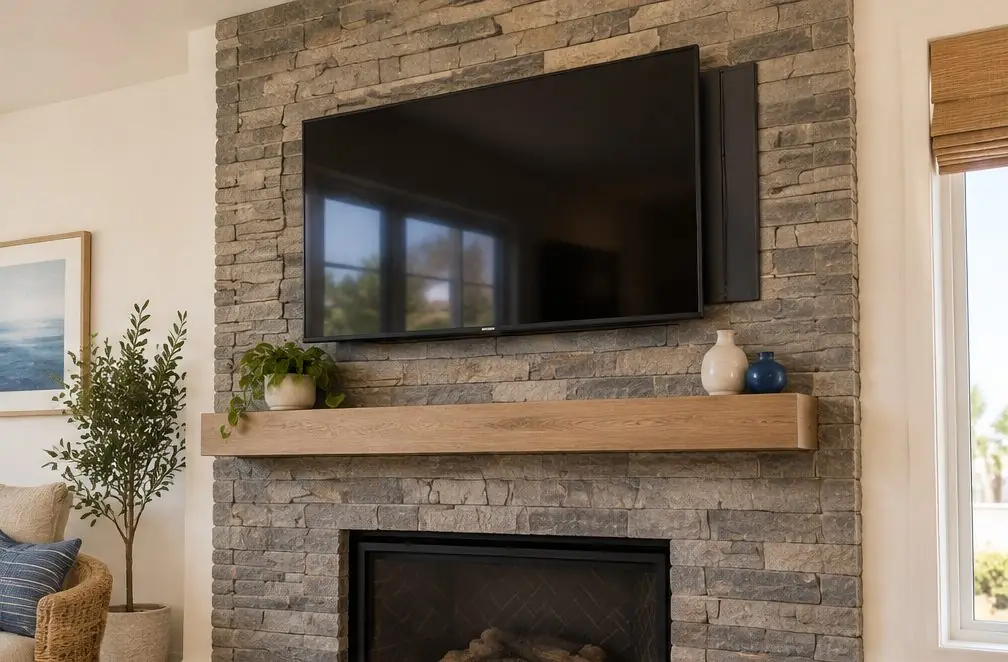 Illustration
TV Above a Fireplace in Costa Mesa, CA typically runs $180–$544 per TV in our 2027 estimator, depending on the TV size and the wall type. Use the estimator below for your own numbers.
Brick, ledger stone or a plastered chimney breast
Costa Mesa fireplaces fall into three groups, and each takes a different fixing. A probe or a careful look at an unfinished edge tells which group a hearth belongs to before any anchor is chosen.
| Surround | Usually found | How the bracket is held |
|---|---|---|
| Brick, painted or bare | Original 1950s and 1960s living rooms | Sleeve anchors set into the face of whole bricks |
| Ledger stone or thin stone veneer | Remodels from the last twenty years | Anchors into solid stone; with thin veneer, through it into the framing |
| Plaster or drywall over a framed chase | Some tract houses and many gas-insert remodels | Lag bolts into the wood framing of the chase |
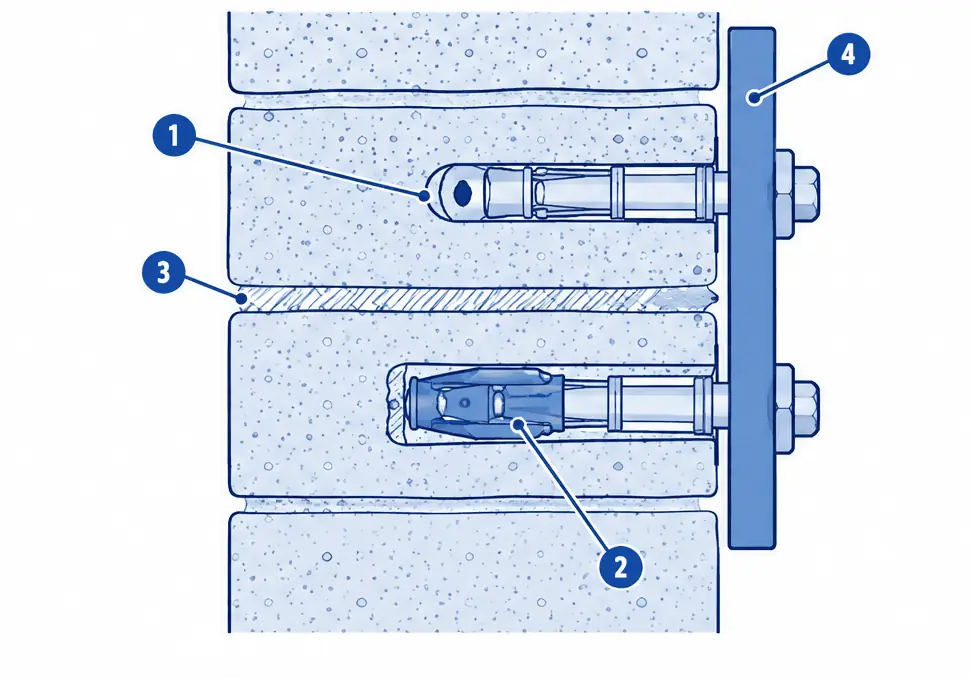
What the numbers show
- Hole in a whole brick Drilled at the center of the brick face, away from the joints above and below.
- Sleeve opened up Turning the bolt pulls a cone into the sleeve, which spreads against the sides of the hole.
- Mortar line Weaker and crumblier than the brick, so it is never used to hold an anchor.
- Plate on the face Once tightened, the anchors pull the plate tight and flat to the masonry.
The warm-wall test
Wood fires leave soot and rising heat on the face above the opening, and a gas insert blows warm air out of its top louvers. Neither suits electronics if it is strong. Two checks settle it. First, both manuals: the TV's operating range and the fireplace maker's clearance to anything mounted above. Second, the hand test after an evening fire: if the spot where the screen will hang is uncomfortable to touch, it is too warm.
When the test fails, the options are a deeper mantel shelf that deflects the heat, a higher screen on a pull-down arm, or a different wall altogether. Many Costa Mesa families rarely light the fire in a mild winter, but the plan still assumes it will be used.
Lowering a high screen with a pull-down arm
Most mantels put the bottom of the screen at four and a half feet or more, which lifts the center of the picture far above a seated viewer's eyes. A tilt helps only a little. A pull-down arm lets the set rest high and flat when the room is in use for other things, then glides down in front of the mantel for a film.
| Mantel height | Mount that usually works |
|---|---|
| Low, with a short chimney wall | Fixed mount, screen as low as the mantel allows |
| Average | Tilting mount aimed at the sofa |
| Tall or with a deep shelf | Pull-down arm with a measured swing path |
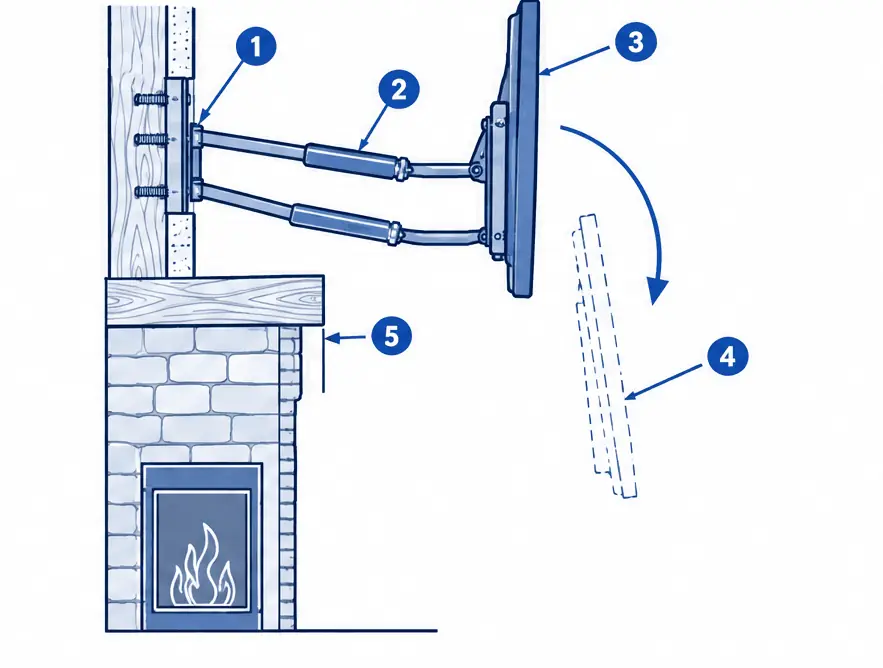
What the numbers show
- Bracket on the chase framing Bolted through the finish into the framing, which takes the load of the arms and the set.
- Spring cylinders Gas springs in the paired arms offset the screen's weight, so one hand can move it.
- Resting position Up and flat against the wall, clear of the warm air over the opening.
- Viewing position Drawn down in front of the mantel to roughly the eye level of a seated viewer.
- Shelf depth Measured first so the arc of the screen clears the mantel's front edge.
Getting the cables down a masonry chimney
Solid brick and stone leave no hollow bay for an in-wall power kit. The usual route is a slim raceway along the side edge of the chimney breast, painted the color of the brick or the wall, down to a receptacle that is already there. On a framed and plastered chase the cavity may be open, but the warm flue sits inside it, so a rated kit is used only after the cavity has been checked. A new outlet near the mantel is an electrician's job.
TV Above a Fireplace — common questions
How much is a TV above a fireplace in Costa Mesa?
From about $180 for a 32–49 inch set on a plastered chimney wall with the fireplace add. A 50–65 inch TV on stone with the fireplace add and a supplied pull-down mount runs a typical $300–$525 in 2027.
My fireplace is painted brick from the 1950s. Is that a problem?
No. Paint does not change the fixing; the anchors still go into whole bricks, and the paint around each hole is taped to keep it from flaking.
What if the wall gets hot when the fire is lit?
Then the screen goes higher on a pull-down arm, a deeper mantel is added, or the TV moves to another wall.
Availability & price range
TV Above a Fireplace: check availability and price range
Bookings aren't open yet — answer a few quick questions about the TV and the wall and get a typical Costa Mesa price range right here. Typical Costa Mesa prices for one TV, labor only unless an option says otherwise. This is a market estimate, not a quote.